Photo by Margaret Walker
Mothers & Others For Clean Air was featured in this article by Margaret Walker at the Macon Telegraph. Read the original article here.
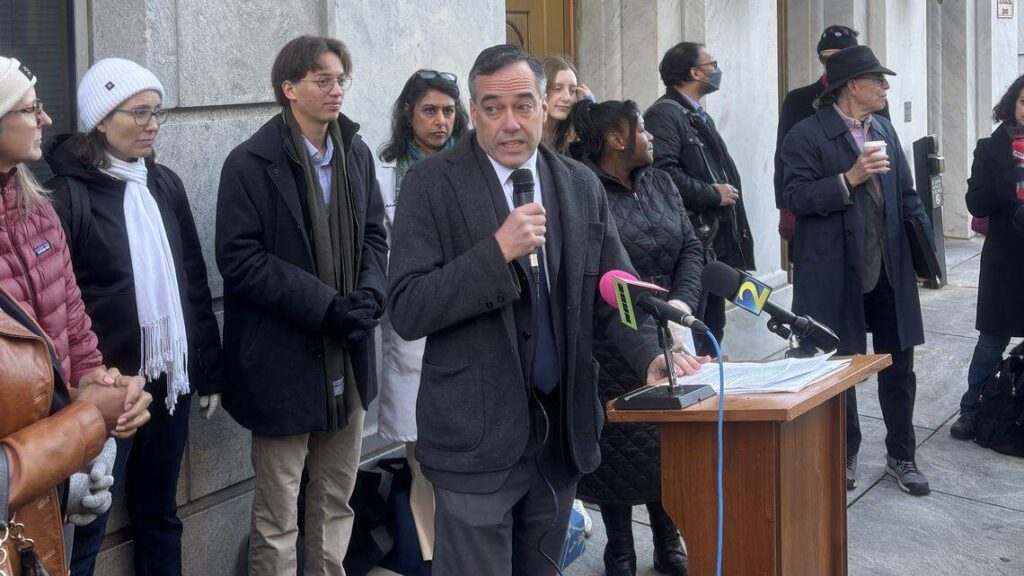
At a Wednesday morning press conference outside the Public Service Commission, environmental and health advocates urged regulators to sharply scale back Georgia Power’s request for 10,000 megawatts of new energy — an expansion which largely would be dominated by new natural gas plants intended largely to power the state’s rapidly expanding data center industry. Georgia Power’s request is currently being weighed by the five-member PSC, and those commissioners will vote on it next week. Hearings are underway this week to help the PSC be more informed about the decision. But advocates hope they won’t give full approval to the plan.
Instead, those speaking at the press conference urged the commission to follow previous suggestions made last month by the PSC staff, whose job is to independently assess Georgia Power’s plans and safeguard the public interest against cost issues or other factors. PSC staff advised its commission to only approve one-third of Georgia Power’s 10,000-megawatt request because that portion is the only slice backed by firm customer contracts, while the rest relies on speculative data-center demand that could leave ratepayers footing the bill if companies relocate or never build. However, as the news conference kicked off Wednesday, the discussion took a turn: Georgia Power announced that it had reached a stipulation agreement with the same PSC staff who had asked commissioners not to approve the full request. The agreement, signed by both Georgia Power and PSC staff representatives, gives staff approval for the full 10 gigawatts on the condition that some savings are provided back to customers — roughly $102 per year for a typical residential customer.
Georgia Power CEO, chair and president Kim Greene said the new plan means “more money stays in your pocket while we power Georgia’s future.”
“Today marks the final set of hearings for the Public Service Commission to decide whether to certify 10,000 megawatts of mostly gas-fired generators and batteries that will be used to power data centers,” said Commissioner-elect Peter Hubbard, a Democrat who scored a significant victory in a commission race just last month. His term starts in January. “This is an extraordinary request to certify and build resources equal to expanding the grid by 60% in just six years. The request comes with a heavy price tag of nearly $17 billion, but the real cost to build and operate these resources over their 45-year life span is between $50 and $60 billion.”
One of Hubbard’s concerns is that a cost-of-service study, a key financial analysis, was never completed after a rate case was canceled earlier this year, making it impossible to ensure that residential customers would not absorb the risks and long-term costs of a massive, decades-long fossil-fuel expansion, according to Hubbard.
Speakers also urged the commission to postpone any decisions until the two newly-elected commissioners, Hubbard and Democrat Alicia Johnson, can actually take office. The vote is scheduled for Dec. 19, but the PSC’s deadline isn’t until March, and the vote could be postponed as long as it remains in that window.
“The Public Service Commission has until March to vote on Georgia Power’s massive and costly resource plan,” said Tanya Coventry-Strader, executive director of Mothers & Others for Clean Air, one of the hosts of the press conference. “Yet there’s pressure to vote on December 19 before two newly elected commissioners can take their seats and represent the voters. Georgia deserves better than a rushed decision on a question that’s important.”
‘If you’re not at the table, then you’re on the menu’
Hubbard reacted to the new stipulation agreement at the news conference. “I feel like this decision was kind of already pre-baked, in a sense,” Hubbard said. “I don’t know what was going on behind closed doors … and if you’re not at the table, then you’re on the menu, and that appears to be what happened today.” Throughout the event, speakers argued that Georgia Power’s proposal — and the PSC’s vote — will have profound consequences for electricity bills, public health, climate change, and the risk that residential customers will subsidize energy infrastructure for private data center companies with short-term contracts and the ability to leave the state.
“To be clear, there are far better alternatives to gas-fired power, which locks us into years of harmful carbon emissions public health impacts from the pollution that pours into surrounding communities,” Hubbard said. “I do not believe we should approve any new fossil fuel generation because it will raise power bills, it will harm public health, it will exacerbate climate change, and because there are better alternatives.“
Beyond financial impacts, the health costs are profound too, according to Dr. Preeti Jaggi, of Emory University.
“Communities near new natural gas plants are at risk for higher rates of respiratory illnesses, cardiovascular problems, and other pollution-related health conditions,” Jaggi said. “The decision by the PSC isn’t just about energy or money — it’s about protecting the health and wellbeing of Georgians for decades to come.”
Carbon pollution is taking a toll on both public health and household budgets. Although Georgia’s rate freeze this year allows cost recovery for Hurricane Helene, critics at Wednesday’s news conference say residents will still see higher bills for a storm intensified by climate change — while policies continue to lock in more coal and gas dependence.
Climate change fuels extreme weather events, from dangerous heat that keeps children indoors to storms like Helene that devastated communities and claimed 229 lives, Jaggi said. Warming winters also extend mosquito and tick seasons, spreading diseases such as Lyme into new areas.
“The current commissioners are not taking into account the health effects of a massive expansion of particularly methane gas,” said Jaggi. “There’s no formal study being done to quantify the lives that will be affected, the lives that will be lost, and the quality of life disruptions that these decisions will cause. We should delay this vote until such an analysis can be performed and presented publicly, so that Georgians understand how these decisions will affect them.“